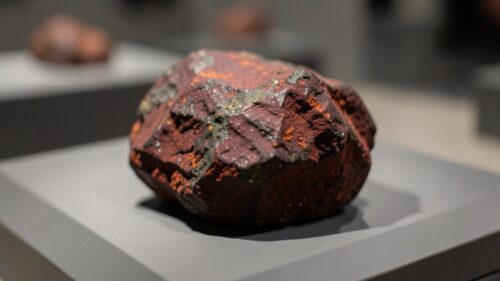
Australian Prospector’s 17-Kg Find Turned Out to Be 4.6-Billion-Year-Old Meteorite
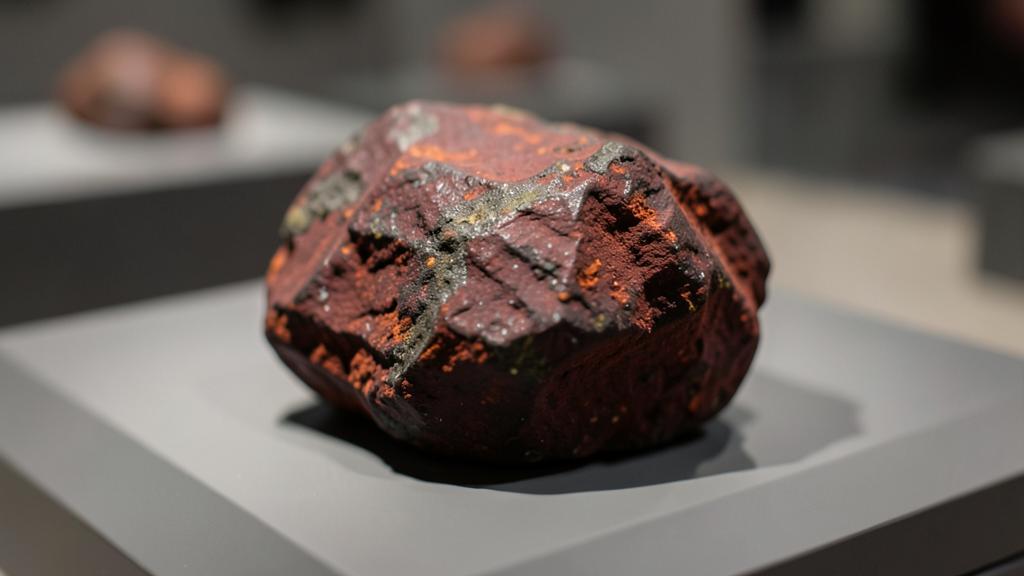
In May 2015, an Australian prospector named David Hole was searching for gold in Maryborough Regional Park near Melbourne, Victoria. Armed with a metal detector, he picked up a signal that led him to an unusually heavy, reddish rock buried in the earth. Weighing a massive 17 kilograms, the strange specimen was remarkably heavy and dense for its size. Hole assumed there was something valuable concealed within its tough outer layer and believed he had struck it rich with a large gold nugget. His discovery, which would later be identified as the Maryborough meteorite, was carried home in hopes of opening it to retrieve the precious metal inside.
Hole kept the reddish rock in his shed for three years while making repeated, futile attempts to crack it open. Believing a fortune in gold was locked inside, he tried using various tools over the years to cut, smash, and break open the dense outer crust. Despite his repeated efforts, the stubborn rock refused to split or chip. After three years of trying to smash it open without success, Hole finally decided in 2018 to take the 17-kilogram specimen to the Melbourne Museum in Victoria to find out what was making it so extraordinarily heavy.
When experts at the museum inspected the rock, they delivered a surprising verdict to the gold prospector. Geologists Dermot Henry and Bill Birch examined the specimen and confirmed that it was not gold at all, but a 4.6-billion-year-old meteorite from outer space. Scientists officially named the space visitor the Maryborough meteorite after the nearby regional Victorian town close to where Hole had dug it up.
A Space Visitor Far Rarer Than Gold
Researchers at the museum emphasized that while prospectors routinely search the Victoria region for gold nuggets, space rocks of this caliber are far rarer and much more valuable to science. Unlike ordinary Earth rocks or minerals, the 17-kilogram specimen originated in outer space billions of years ago and survived a high-speed descent through Earth’s atmosphere before coming to rest in Maryborough Regional Park.
Dermot Henry explained the immense scientific significance of the 17-kilogram discovery. “Meteorites provide the cheapest form of space exploration,” said Henry. “They transport us back in time, providing clues to the age, formation, and chemistry of our Solar System (including Earth).” The rock’s unique extraterrestrial composition and extreme density explained why Hole’s futile attempts to smash it open with tools had failed continuously over the three years it sat in his shed.
Preserved at Melbourne Museum
The researchers noted that the 4.6-billion-year-old Maryborough meteorite serves as a natural cosmic capsule, offering scientists rare insights into the early chemistry and formation of the solar system. Rather than containing gold nuggets to sell, the rock proved to be an extraordinary scientific find that is far more precious than gold.
Today, the 17-kilogram space rock is held safely in a Victorian museum collection. It remains preserved at the Melbourne Museum, where researchers continue to study the ancient specimen to uncover more about its cosmic history.
Based on reports from
- Man Keeps a Rock For Years, Hoping It's Gold. It Turned Out to Be So Much More Valuable — ScienceAlert
- In 2015, a prospector in Australia dug up a heavy reddish rock and hoped for gold inside. Three years later, a museum told him it was a 4.6-billion-year-old meteorite — Futura, le média qui explore le monde
- Australian man finds a strange 17-kg rock while searching for gold; years later, scientists identify it a — The Times of India
About The Author