TOKYO–(BUSINESS WIRE)–Thailand’s trade is no longer to take place between independent exporters and importers, or between intra-firms of transnational corporations (TNCs), but also through non-equity modes (NEMs) of production. This mode of exports has been increasing, reaching an estimated at least $150 billion in goods and services, or 48% of total exports from Thailand in 2016, according to new findings by the ASEAN-Japan Centre on NEMs in the report (Non-Equity Modes of Trade in ASEAN: Thailand [https://www.asean.or.jp/en/trade-info/nem_papers/]), released in April.
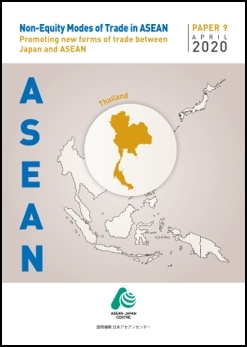
Thai firms are involved in various types of NEMs, including contract farming, subcontracting, management contract and franchising. The type of NEM varies by industry.
The automotive industry is one of highest generators of exports and employment in NEM businesses engaged in subcontracting. Convenience stores are typically operated through franchising and licensing agreements.
Offshoring businesses are emerging in some industries, reflecting advances in design power, information technology skills and a wide range of consumer interest. One such example is the entertainment content industry. The total revenue of this industry is about $6.3 billion.
By establishing NEM agreements with TNCs, local firms and their industry can benefit from a number of business opportunities. However, there are also challenges for local firms, particularly because of the characteristics of NEMs and the unique experiences of industrial development (e.g. dominance of large firms) in Thailand. TNCs can easily terminate their contracts, particularly if the quality of services or goods supplied does not meet their competitive standards or when more competitive suppliers emerge in other countries.
Therefore, the government should assist in the development of NEM capabilities so that local firms can take advantage of appropriate TNC-driven economic synergies as competition forces TNCs to make continuous improvements in the quality and pricing of suppliers.
Because of no equity relationship the TNC governance is sometimes almost absent in local NEM firms. The government thus cannot rely on the compliance level and guidance of foreign clients for the governance of local NEM firms.
The government should consider implementing and strengthening the regulatory framework for NEM firms to enable NEM firms to export, promote innovation, expand their employment and upgrade technologically.
Contacts
ASEAN-Japan Centre
Tomoko Miyauchi
URL: www.asean.or.jp/en/
Email: toiawase_ga@asean.or.jp