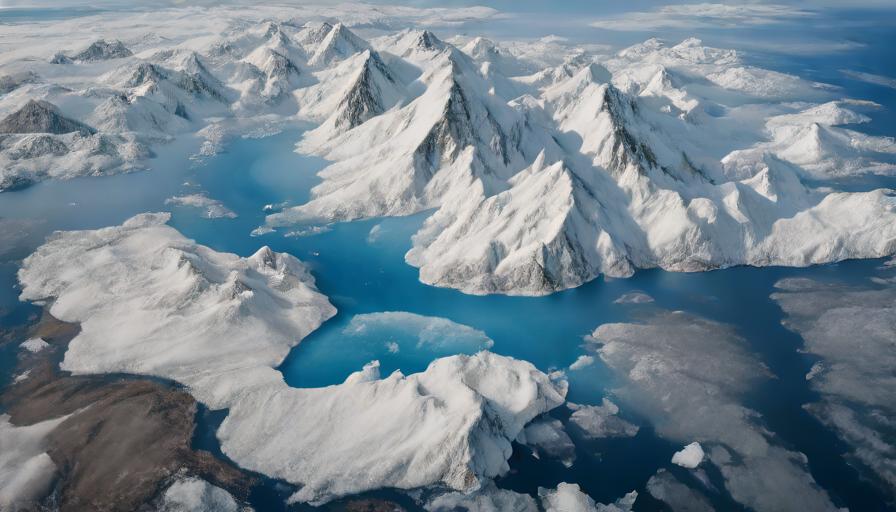
- Greenland is the world's largest island, covering 2.16 million square kilometers, with approximately 80% of its landmass covered by an ice sheet.
- Politically, Greenland is an autonomous territory within the Kingdom of Denmark, holding self-rule over internal affairs while Denmark manages defense and foreign policy.
- The Greenland Ice Sheet contains nearly 8% of Earth's freshwater supply and loses roughly 270 billion metric tons of ice annually due to warming temperatures.
- There are no roads or railways connecting towns in Greenland; transportation relies entirely on airplanes, helicopters, boats, and snowmobiles.
Greenland is the world’s largest island, operating as an autonomous territory within the Kingdom of Denmark located between the Arctic and Atlantic oceans. Covering an area of 2.16 million square kilometers (836,330 square miles), approximately 80% of its landmass is covered by a massive, continuous ice sheet. Despite its vast geographical footprint, Greenland facts show a population of roughly 56,600 inhabitants, making it the least densely populated territory on Earth.
Where is Greenland Located and What is Its Political Status?
Geographically, Greenland forms part of the North American continent, situated northeast of Canada and northwest of Iceland. Politically, however, the island has been associated with Europe for over a thousand years. Greenland became a formal Danish colony in 1814 and was fully integrated into the Danish Realm in 1953. Denmark granted Greenland Home Rule in 1979, which evolved into enhanced Self-Rule status in 2009 following a nationwide constitutional referendum.
Under the Act on Greenland Self-Government of 2009, the Greenlandic parliament (Inatsisartut) and government (Naalakkersuisut) hold self-determination and legislative authority over domestic policy, natural resource management, taxation, and judicial administration. The Kingdom of Denmark retains responsibility for national defense, foreign affairs, monetary policy, and citizenship. Nuuk functions as the capital city, housing approximately 19,800 residents, which accounts for more than one-third of the island’s total population.
What is the Greenland Ice Sheet and Why Is It Significant?
The Greenland Ice Sheet is the second-largest glacial body in the world, surpassed only by the Antarctic Ice Sheet. Covering roughly 1.71 million square kilometers (660,000 square miles), the ice sheet measures up to 3 kilometers (1.9 miles) thick at its thickest central point. It contains approximately 2.85 million cubic kilometers of frozen freshwater, representing nearly 8% of the global freshwater supply.
Glaciologists pay close attention to Greenland because its complete melting would raise global sea levels by approximately 7.4 meters (24 feet). Key outlet glaciers, such as Jakobshavn Isbræ (known in Greenlandic as Sermeq Kujalleq), drain significant portions of the interior ice into Disko Bay. Sermeq Kujalleq is one of the most active glaciers in the Northern Hemisphere, flowing at speeds exceeding 40 meters per day in peak summer months and calving thousands of icebergs annually into the ocean.
Key Greenland Facts and Geography Metrics
The following structured data provides a quick overview of key geographic, demographic, and political metrics defining Greenland:
| Metric | Value | Details |
|---|---|---|
| Total Area | 2,166,086 sq km | ~80% ice sheet, ~20% ice-free coast |
| Population | ~56,600 (2024 est.) | ~88% Inuit, ~12% Danish/European |
| Capital City | Nuuk | Home to ~19,800 residents |
| Official Language | Greenlandic (Kalaallisut) | An Inuit-Yupik linguistic family |
| Primary Currency | Danish Krone (DKK) | Pegged to Euro via ERM II |
| Top Export | Seafood | Halibut and shrimp (>90% of total) |
How Does the Economy and Transport System Work in Greenland?
Greenland’s economic baseline depends heavily on commercial fishing, public sector spending, and direct financial subsidies from Denmark. Fisheries generate over 90% of Greenland’s physical goods exports, with Greenland halibut (Reinhardtius hippoglossoides) and deep-sea cold-water shrimp (Pandalus borealis) serving as the primary commercial species. The Danish government supplies an annual block grant (bloktilskud) of roughly 3.9 billion Danish kroner (approximately $560 million USD), providing essential funding for civil services, infrastructure, and healthcare systems.
Due to deep fjords, mountainous shorelines, and unstable glacial margins, no intercity roads or railways connect towns in Greenland. Transportation between settlements relies entirely on aviation, maritime vessels, and snowmobiles or dog sleds in northern communities. Air Greenland operates domestic flights linking regional airstrips, while coastal ferry services like the Arctic Umiaq Line carry passengers along the southwestern coast. Ongoing international airport construction projects in Nuuk and Ilulissat aim to enable direct long-haul flights to Europe and North America.
Who Are the Indigenous Inhabitants and Historical Cultures of Greenland?
Human occupancy in Greenland spans over 4,500 years, marked by successive waves of Arctic hunter-gatherer migrations from northern Canada. The earliest documented groups include the Saqqaq, Independence, and Dorset cultures. The direct ancestors of modern Greenlanders, the Thule people, entered northern Greenland around 1000 CE, bringing advanced whaling technologies, kayaks, and dog sleds adapted to extreme polar conditions.
During the same historical window around 986 CE, Norse settlers led by Erik the Red established agrarian communities along the southwestern fjords. These Norse settlements thrived for nearly five centuries before disappearing in the 15th century. Researchers attribute their decline to changing climatic conditions during the Little Ice Age, economic isolation, and shifting global trade dynamics. Today, approximately 88% of the country’s population consists of Greenlandic Inuit (Kalaallit), with the official language being Kalaallisut.
What Role Does Greenland Play in Global Climate Science?
Greenland sits at the forefront of global climate change research because the Arctic region warms at more than double the rate of the global average—a condition called Arctic amplification. Satellite telemetry from NASA’s GRACE project indicates that Greenland loses an average of 270 billion metric tons of ice every year, adding roughly 0.75 millimeters annually to rising ocean levels worldwide.
In addition to sea level contributions, the massive discharge of cold freshwater into the North Atlantic threatens to weaken the Atlantic Meridional Overturning Circulation (AMOC), a crucial system of ocean currents regulating weather patterns across Western Europe and North America. Scientific research facilities, including Summit Station located 3,200 meters above sea level atop the central ice sheet, continuously collect ice core samples that provide atmospheric data spanning more than 100,000 years of Earth’s climate history.
Frequently Asked Questions
Is Greenland an independent country?
Greenland is not a fully independent country, but an autonomous territory within the Kingdom of Denmark. Under the 2009 Act on Greenland Self-Government, Greenland controls its local government, legal system, tax policies, and natural resources, while Denmark retains authority over national defense, foreign policy, and monetary policy.
Why is Greenland named Greenland if it is mostly ice?
Greenland was named by the Norse explorer Erik the Red around 982 CE. According to medieval Icelandic sagas, Erik chose the name 'Greenland' (Grœnland) as a clever marketing tactic to entice potential Scandinavian settlers to move to the newly discovered territory, despite its extensive ice coverage.
How do tourists travel to and within Greenland?
Tourists travel to Greenland on commercial flights operating primarily out of Denmark and Iceland. Because no roads connect Greenlandic settlements, travel inside the country requires regional flights with Air Greenland, passenger travel on the Arctic Umiaq Line ferry, helicopter charters, or dog sled and snowmobile expeditions during winter.