- The Indian Navy protects a 7,516-kilometer coastline and oversees critical sea lanes across the Indian Ocean region.
- With over 67,000 active personnel, the navy operates two aircraft carriers: INS Vikramaditya and the indigenously built INS Vikrant.
- India's naval forces are organized under three regional commands based in Mumbai, Visakhapatnam, and Kochi, alongside a joint command in Port Blair.
- Under the Atmanirbhar Bharat initiative, over 40 naval vessels are actively being constructed in Indian shipyards to achieve complete self-reliance by 2047.
The Indian Navy is the maritime branch of the Armed Forces of India, tasked with safeguarding the nation’s 7,516-kilometer coastline and protecting its strategic interests across the Indian Ocean. Tracing its historical roots to the East India Company’s Marine established in 1612, the force was officially designated as the Royal Indian Navy in 1934 before dropping the Royal prefix when India became a republic on January 26, 1950. Today, the Indian Navy ranks among the premier naval forces globally, operating a balanced blue-water fleet capable of power projection, littoral defense, and humanitarian missions.
What is the Indian Navy’s organizational structure?
The President of India serves as the Supreme Commander of the Indian Navy, while executive command rests with the Chief of the Naval Staff (CNS), a four-star Admiral based at Naval Headquarters in New Delhi. Operational capabilities are decentralized across three regional commands:
- Western Naval Command: Headquartered in Mumbai, responsible for operations in the Arabian Sea and security along the western coastline.
- Eastern Naval Command: Headquartered in Visakhapatnam, overseeing operations in the Bay of Bengal and eastern maritime borders.
- Southern Naval Command: Headquartered in Kochi, functioning as the primary training command for all naval officers and enlisted personnel.
In addition to these three geographical commands, the navy contributes assets and personnel to India’s unified tri-service command, the Andaman and Nicobar Command located at Port Blair. This strategic outpost monitors critical maritime chokepoints, including the Strait of Malacca.
How big is the Indian Navy? Fleet size and personnel
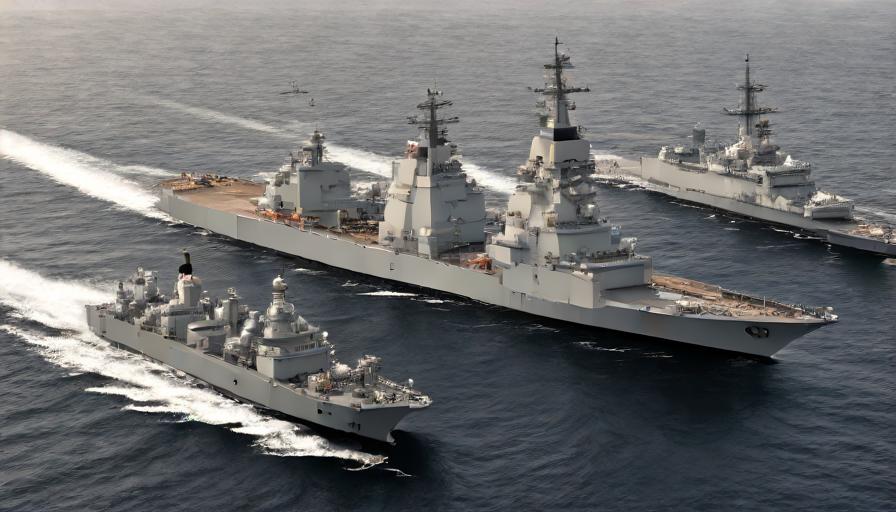
As of 2024, the Indian Navy maintains an active strength of approximately 67,000 personnel, supported by over 75,000 reserve forces. Its operational fleet comprises more than 150 warships, submarines, and auxiliary vessels, along with an aviation wing operating over 300 aircraft.
| Asset Category | Operational Assets | Key Examples |
|---|---|---|
| Aircraft Carriers | 2 | INS Vikramaditya, INS Vikrant |
| Guided-Missile Destroyers | 12+ | Visakhapatnam-class, Kolkata-class |
| Stealth Frigates | 12+ | Shivalik-class, Talwar-class |
| Submarines | 16+ | Arihant-class (SSBN), Kalvari-class (SSK) |
| Naval Aviation | 300+ aircraft | MiG-29K, MH-60R Seahawk, P-8I Poseidon |
The fleet’s blue-water capabilities enable continuous deployment in the Arabian Sea, the Bay of Bengal, and the wider Indo-Pacific region, ensuring uninterrupted commercial shipping and regional maritime security.
What are the primary warships and submarines of the fleet?
The capital ships of the Indian Navy are its aircraft carriers, which serve as mobile airbases for sea control operations. INS Vikramaditya, a 45,000-tonne carrier acquired from Russia, entered service in 2013. In September 2022, India commissioned its first indigenously designed and built aircraft carrier, INS Vikrant (IAC-1). Constructed by Cochin Shipyard Limited, the 45,000-tonne INS Vikrant highlights India’s defense engineering capability, featuring 76 percent domestic content.
Undersea deterrence is maintained through a combination of diesel-electric and nuclear-powered submarines. The strategic force is anchored by INS Arihant, India’s first nuclear-powered ballistic missile submarine (SSBN), which completes the nation’s nuclear triad. Conventional submarine capabilities are bolstered by the Kalvari-class diesel-electric submarines, based on the French Scorpène design and constructed at Mazagon Dock Shipbuilders Limited in Mumbai. Surface combatants include advanced guided-missile destroyers like the Visakhapatnam-class (Project 15B), equipped with BrahMos supersonic cruise missiles and long-range surface-to-air missiles.
How is the Indian Navy modernizing under Atmanirbhar Bharat?
Modernization efforts within the Indian Navy align closely with the government’s Atmanirbhar Bharat (Self-Reliant India) initiative. The navy aims to become a fully self-reliant force by 2047, the centenary year of India’s independence. Out of more than 40 ships and submarines currently under order or construction, nearly all are being built in Indian shipyards, including Mazagon Dock Shipbuilders, Garden Reach Shipbuilders & Engineers, and Goa Shipyard.
Technological upgrades prioritize indigenous weapons systems and sensors. Key domestic developments include the BrahMos supersonic cruise missile, the Varunastra anti-submarine heavyweight torpedo, and advanced sonar systems like HUMSA-NG. The navy is also integrating unmanned systems, acquiring MQ-9B SeaGuardian high-altitude long-endurance drones for real-time maritime domain awareness across critical sea lines of communication.
Major missions, anti-piracy, and humanitarian operations
Throughout its modern history, the Indian Navy has played a decisive role in national security and international maritime stability. During the Indo-Pakistani War of 1971, the navy conducted Operation Trident and Operation Python, executing successful missile boat attacks against Karachi port and establishing a blockade in the Bay of Bengal.
In the 21st century, the navy expanded its posture to include counter-piracy patrols in the Gulf of Aden and the Western Arabian Sea. Since 2008, Indian warships have escorted thousands of merchant vessels and thwarted multiple pirate hijackings, demonstrating its role as a net security provider in the region. Under Operation Sankalp, initiated in 2019, naval ships maintain a continuous presence in the Persian Gulf to guarantee the safe passage of Indian-flagged commercial vessels.
The navy is also a major responder for Humanitarian Assistance and Disaster Relief (HADR) in the Indo-Pacific. Operations during the 2004 Indian Ocean Tsunami, Operation Rahat (Yemen evacuation in 2015), and Operation Samudra Setu (repatriating citizens during the COVID-19 pandemic) demonstrate its capacity for swift non-combatant evacuations and emergency relief delivery.
{
“html”: “
What is the future roadmap for the Indian Navy?
To strengthen maritime force projection and maintain strategic readiness across the Indo-Pacific, the Indian Navy is pursuing a comprehensive 175-ship fleet vision by 2035. Central to this roadmap is the acquisition of a third aircraft carrier (IAC-2), envisioned as a
Frequently Asked Questions
What is the primary role of the Indian Navy?
The primary role of the Indian Navy is to protect India's maritime borders, secure its Exclusive Economic Zone (EEZ), and safeguard sea lines of communication across the Indian Ocean. Additionally, the navy conducts anti-piracy patrols, maritime domain surveillance, and Humanitarian Assistance and Disaster Relief (HADR) missions across the Indo-Pacific region.
How many aircraft carriers does the Indian Navy operate?
The Indian Navy operates two active aircraft carriers: INS Vikramaditya, acquired from Russia and commissioned in 2013, and INS Vikrant, India's first indigenously built aircraft carrier commissioned on September 2, 2022. Both carriers serve as capital ships for sea control and fleet air defense.
Where are the operational commands of the Indian Navy located?
The Indian Navy operates three primary geographical commands: the Western Naval Command in Mumbai, the Eastern Naval Command in Visakhapatnam, and the Southern Naval Command in Kochi, which focuses on training. It also contributes forces to the joint-services Andaman and Nicobar Command based at Port Blair.