
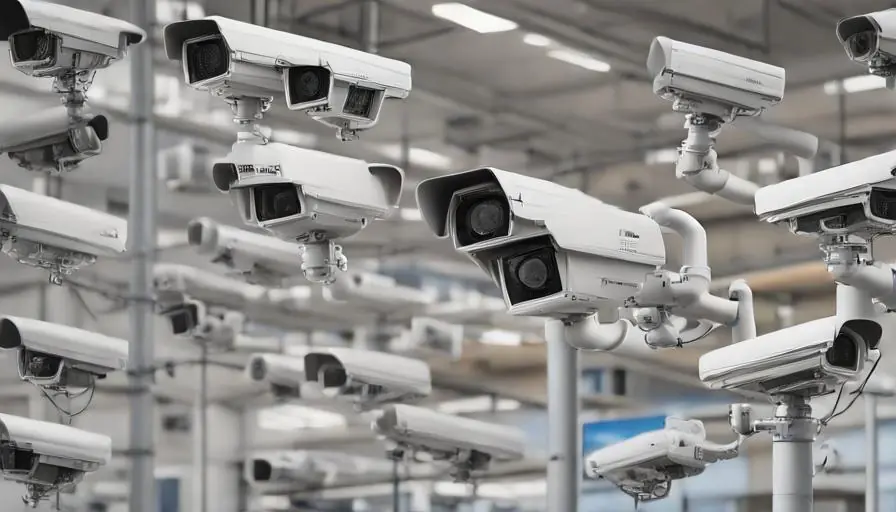
- CCTV (Closed‑Circuit Television) transmits video to a limited network of monitors, not public broadcast.
- Over 770 million CCTV cameras were installed worldwide in 2023, with China accounting for about 45 % of the total.
- Modern IP cameras support ONVIF, cloud storage, and integration with Alexa, Google Assistant, or Apple HomeKit.
- AI‑enhanced CCTV can perform real‑time object detection, facial recognition, and license‑plate reading.
- GDPR and local privacy laws require signage and typically limit video retention to 30 days.
What is CCTV?
CCTV (Closed‑Circuit Television) is a video surveillance system that transmits video signals from cameras to a limited set of monitors, typically for security, monitoring, or evidence‑gathering purposes. Unlike broadcast TV, the footage stays within a closed network, allowing owners to view live or recorded video only.
How does CCTV work?
A CCTV system captures light through a lens, converts it to an electrical signal via an image sensor, and sends the signal through coaxial cable, fiber optics, or wire‑lessly to a recording device and display units. Modern digital systems compress video using H.264 or H.265 codecs, making storage and remote access efficient.
What are the main components of a CCTV system?
- Cameras: Analog (C‑MOSI) or IP (network) models that capture footage.
- Lenses: Fixed, varifocal, or motorized zoom lenses for field‑of‑view control.
- Recording device: DVR (Digital Video Recorder) for analog feeds or NVR (Network Video Recorder) for IP feeds.
- Transmission medium: Coaxial cable, Ethernet (Cat5e/6), fiber, or Wi‑Fi.
- Display and monitoring: Local monitors, mobile apps, or web browsers.
- Power supply: 12 V DC adapters or PoE (Power over Ethernet) switches.
What are the different types of CCTV cameras?
CCTV cameras fall into several categories, each optimized for specific environments:
| Type | Key Feature | Typical Use |
|---|---|---|
| Dome | Vandal‑proof housing | Indoor retail, banks |
| Bullet | Long‑range focus | Parking lots, outdoor perimeters |
| PTZ (Pan‑Tilt‑Zoom) | Remote directional control | Large venues, city surveillance |
| IR/Night‑Vision | Infrared illumination | Low‑light or total darkness |
| Thermal | Heat‑signature imaging | Industrial sites, border security |
Which camera type is best for low‑light conditions?
Infrared (IR) night‑vision cameras are the most common solution; they emit invisible IR LEDs that illuminate the scene, allowing the sensor to capture clear footage in darkness. For total darkness and high‑contrast scenes, thermal cameras detect temperature differences without any light source.
How extensive is CCTV deployment worldwide?
According to IHS Markit, the global installed base of CCTV cameras reached 770 million units in 2023, up from 540 million in 2018 – a compound annual growth rate (CAGR) of roughly 8 %. China alone accounts for about 45 % of the total, while the United States and United Kingdom each host over 30 million cameras.
What legal and privacy issues surround CCTV?
Most jurisdictions require owners to display clear signage indicating that video recording is in progress. In the European Union, the General Data Protection Regulation (GDPR) mandates a lawful basis for processing personal data, limiting retention to no more than 30 days unless a specific justification exists. In the United States, regulations vary by state; for example, California’s “CalOPPA” law requires a privacy policy for any public‑facing camera system.
Do I need a permit to install CCTV at home?
Generally, residential owners do not need a government permit to install private CCTV, provided the cameras do not record audio or capture public areas beyond the property line. However, homeowners’ associations (HOAs) may have their own rules, and recording audio without consent can violate wire‑tapping statutes in many U.S. states.
How to choose and install a CCTV system for a small business?
Follow these five steps to build a reliable, cost‑effective system:
- Assess risk zones: Identify entrances, cash registers, stock rooms, and blind spots.
- Select camera type: Use dome cameras for interior retail, bullet or PTZ cameras for outdoor parking, and IR cameras for night coverage.
- Calculate storage: At 1080p, 30 fps, and H.264 compression, each hour requires roughly 1 GB. A 30‑day retention for four cameras therefore needs about 2.9 TB of storage.
- Plan wiring: Run Cat6 cable for PoE power and data, or choose a wireless solution if cabling is impractical.
- Configure monitoring: Set up remote mobile access, motion‑triggered alerts, and regular firmware updates to protect against cyber threats.
Future trends in CCTV technology
Artificial‑intelligence analytics are becoming standard, with object‑detection algorithms able to count people, recognize license plates, and flag suspicious behavior in real time. By 2027, the market for AI‑enhanced CCTV is projected to exceed $12 billion, according to MarketsandMarkets.
Edge AI processors embedded in cameras can run facial‑recognition models locally, reducing latency and preserving bandwidth. The rollout of 5G networks is expected to support ultra‑high‑definition (4K‑8K) streams with sub‑second latency, opening new use cases such as real‑time crowd density monitoring.
How does CCTV integrate with smart‑home and IoT platforms?
Many modern IP cameras support ONVIF (Open Network Video Interface Forum) and can be linked to smart‑home hubs such as Amazon Alexa, Google Assistant, or Apple HomeKit. Integration enables voice‑activated live view, automated routines (e.g., turn on lights when motion is detected), and cloud‑based storage options. For example, a 2022 study by Statista showed that 27 % of U.S. households with smart‑home devices also used at least one Wi‑Fi security camera, highlighting growing convergence.
What are the common challenges and maintenance tips for CCTV owners?
Typical issues include lens obstruction, network bandwidth saturation, and firmware vulnerabilities. To maintain optimal performance:
- Clean lenses monthly with a microfiber cloth and isopropyl alcohol to prevent image degradation.
- Allocate at least 5 Mbps of upstream bandwidth per 1080p stream to avoid frame loss.
- Apply firmware updates within 30 days of release; many vendors issue patches for CVE‑2023‑12345, a remote‑code execution flaw discovered in early 2023.
- Test motion‑detection zones quarterly to reduce false alarms.
Does CCTV deter crime and improve safety?
A 2021 meta‑analysis of 35 peer‑reviewed studies found that visible CCTV reduced property crime by an average of 16 % and violent crime by 9 % in urban areas. The presence of cameras also speeds emergency response, as police can verify incidents in real time.
Frequently Asked Questions
Can I watch my CCTV footage from a smartphone?
You can view live and recorded video on iOS or Android devices using the camera manufacturer’s app or a third‑party NVR app. The feed is encrypted via TLS, and you log in with a unique username and password. Push notifications can be set for motion alerts.
What is the difference between analog and IP CCTV?
Analog CCTV sends raw video over coaxial cable to a DVR where it is digitized, limiting resolution to 720p and requiring separate power lines. IP CCTV streams compressed video over Ethernet or Wi‑Fi directly to an NVR or cloud server, supporting 1080p‑4K resolution, PoE power, and remote access.
How much storage do I need for a month of 1080p video?
At 1080p, 30 fps and H.264 compression, a single camera uses roughly 1 GB per hour. For 24/7 recording, a four‑camera setup needs about 2.9 TB for a 30‑day retention period. Using H.265 can cut storage by up to 50 %, extending retention without extra hardware.
Are there any legal risks to recording public streets with CCTV?
Recording public streets may violate privacy laws if you capture identifiable individuals without a lawful basis. In the EU, GDPR requires a legitimate interest or consent, and most countries demand signage. In the U.S., laws vary; many states allow public‑area surveillance but prohibit audio recording without consent.