Low turnout, alliance splits and frozen counting make Andhra’s civic polls anyone’s ward-level fight
Low turnout and alliance differences will decide more of the AP election results than any single party’s statewide popularity. The counting that began at 8 am on Tuesday covered 92 urban local bodies, split between 13 municipal corporations and 79 municipalities and nagar panchayats, after polling on November 1. It is not a state election, but it is the first organised civic test for the ruling NDA in towns and cities since it took office, and the numbers already say why it should not be read like one.
The Economic Times reported a voter turnout of 60.96%, with Tirupati recording the lowest figure; India TV News put the tentative turnout at 60.3%. Those two versions have the same story. Nearly four in ten eligible voters stayed away, and that is a different arithmetic from a high-intensity assembly campaign. In a low-turnout civic poll, organised workers, ward-level alliances and local candidate arithmetic often matter more than welfare slogans. The Times of India’s framing is useful here: suspense comes precisely from weak turnout and from differences within the alliance system, not from a uniform wave.
Turnout cuts both ways for the ruling NDA
The ruling NDA is confident that its development and welfare programmes will help its candidates across the state, and that is the strongest version of the government’s case. A party that can deliver tangible schemes has a genuine civic argument. But the same low-turnout conditions that help disciplined workers can also punish a coalition if parts of it do not pull together ward by ward. With turnout around 60%, the contest is expected to be tighter where opposition candidates split anti-NDA votes or where the NDA’s own partners field rivals.
Cyclone Murasu and early ward results already broke the simple script
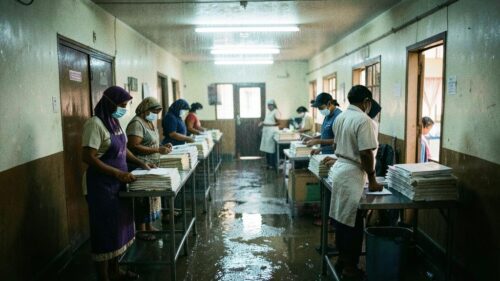
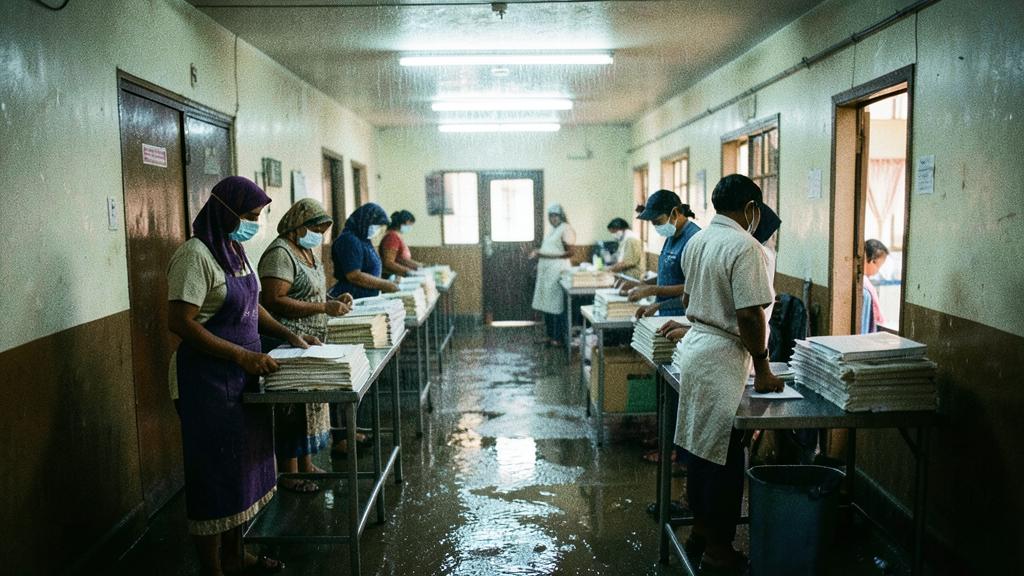
Cyclone Murasu delayed counting in two districts, and heavy rains delayed counting more broadly, so the morning’s rhythm was uneven. In Visakhapatnam, officials and agents arrived at a counting centre near Andhra University Engineering College while Greater Visakhapatnam Municipal Corporation trends showed TDP leading in eight wards. News18 reported Jana Sena winning two wards in Kakinada and YSRCP securing two in Kalyandurg. These are not statewide verdicts. They are proof that the commanding narrative is not moving as one line: the NDA’s Telugu Desam Party was showing strength in the state capital-city corporation while YSRCP was taking wins in Kalyandurg, and Jana Sena was showing it can still convert specific wards in Kakinada. That mix is exactly what the early tension predicted.
The counterargument deserves a fair hearing
The sceptic’s case is that municipal bodies are too local to measure the government in Amaravati. Candidates run on drainage, water, street lights and local patronage. A ward in Kalyandurg need not tell us anything about how Tirupati or Visakhapatnam views the state leadership. That point has force, and the 92-body structure makes it stronger: results will decide political control of urban local bodies, ward by ward, not a government’s survival. The NDA would answer that civic bodies are the closest arena where its development and welfare programmes can be seen by residents, and where alliance partners must show they can add voters rather than merely add symbols.
What is still open
The legal and calendar context keeps the stakes concrete. The high court gave a green signal in Jagan’s Pulivendula, removing one procedural question from a seat that carries outsized political attention. The Andhra Pradesh government has also declared holidays on November 4 and 5 so people can vote in the MPTC and ZPTC elections, meaning the civic season is only moving into its next phase even as these corporation and municipality results land. The open question is narrow and factual: once the rain-delayed counting rooms complete the remaining two districts, which party or alliance centres control the most urban local bodies, and whether the early Visakhapatnam, Kakinada and Kalyandurg patterns repeat across the other 89 bodies.
Based on reports from
- Low turnout, alliance differences add suspense to Andhra Pradesh municipal election results; counting to — The Times of India
- 2026 U.S. House Election Results — AP News
- 2026 election results: Live updates on Congress and governors — Technical.ly
- Andhra Pradesh municipal election result: Counting of votes begins; HC gives green signal in Jagan's Pulivendula | India News — Hindustan Times
- Who decides US midterm election winners on TV? How AP, DDHQ and media networks make calls and why they can — The Economic Times
About The Author