
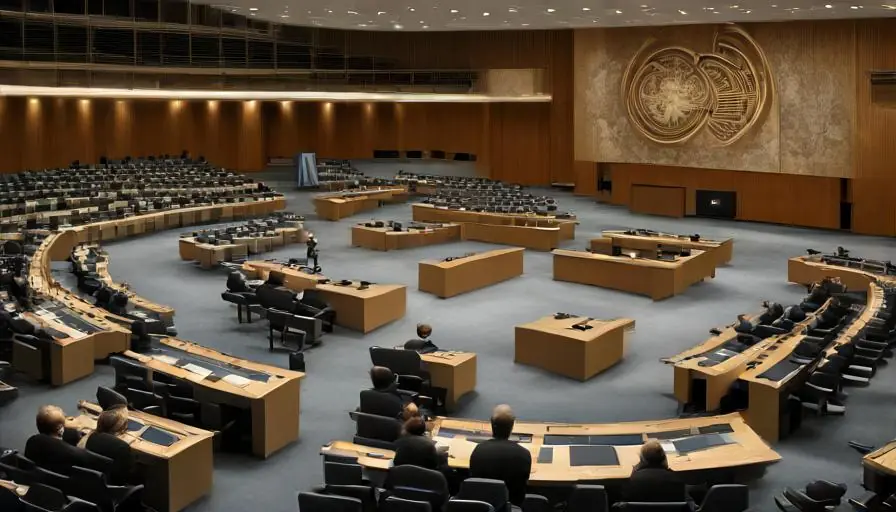
- The UNGA includes all 193 UN member states, each with one vote, making it the most inclusive global forum.
- Important matters such as the UN budget and peace‑keeping mandates require a two‑thirds majority to pass.
- Resolution 217 A (1948) established the Universal Declaration of Human Rights, the UNGA’s most influential non‑binding text.
- Special and emergency sessions can be convened outside the regular September meeting to address crises like the Suez Canal or Gaza.
The United Nations General Assembly (UNGA) is the main deliberative body of the UN where all 193 member states meet annually to discuss and vote on global issues. It adopts resolutions, sets the UN budget, and elects non‑permanent Security Council members.
What is the UNGA and why does it matter?
The UNGA provides a universal platform for every nation, regardless of size or wealth, to voice opinions on peace, development, human rights, and international law. Because each state has one vote, the Assembly balances power among large and small countries, making its decisions a barometer of global consensus.
Founded in 1945, the UNGA held its first session in January 1946 with 51 founding members. Since then, it has grown to include every sovereign state recognized by the United Nations, making it the most inclusive international forum.
How is the UNGA structured?
Member participation and voting rights
All 193 UN members sit in the plenary hall, each with a single vote. Important matters—such as budgetary decisions, peace‑keeping mandates, and admission of new members—require a two‑thirds majority, while most other items pass by a simple majority of those present and voting.
Leadership and committees
The Assembly elects a President for each session, usually rotating among regional groups (Africa, Asia‑Pacific, Eastern Europe, Latin America and the Caribbean, Western Europe & Others). Six main committees handle thematic work: Disarmament and International Security; Economic and Financial; Social, Humanitarian and Cultural; Special Political and Decolonisation; Administrative and Budgetary; and Legal.
Regional groups also determine the distribution of seats on each committee, ensuring that geographical diversity is reflected in the Assembly’s subsidiary bodies.
When does the UNGA meet and what is the agenda?
The regular session opens every year on the third Tuesday of September in New York’s General Assembly Hall and runs for about three months. The agenda is set by the President‑elect in consultation with member states and typically includes:
- Annual report of the Secretary‑General
- Budget and financial assessments
- Peace‑keeping and conflict‑prevention updates
- Sustainable Development Goals (SDGs) progress
- Human rights and humanitarian emergencies
The UNGA can also convene special sessions at the request of the General Assembly, a majority of member states, or the UN Secretary‑General. Since 1946, 12 special sessions have been called, addressing issues such as the Suez Crisis (1956) and the Gaza conflict (2021).
How are UNGA resolutions adopted?
Resolution adoption follows a clear voting procedure:
| Issue type | Required majority |
|---|---|
| Budgetary & membership matters | Two‑thirds of members present |
| Peace‑keeping mandates | Two‑thirds of members present |
| General policy statements | Simple majority |
The most celebrated UNGA achievement is the adoption of the Universal Declaration of Human Rights on 10 December 1948 (Resolution 217 A). Although not a treaty, the declaration has become customary international law and guides countless national constitutions.
Even though UNGA resolutions are not legally binding, they carry strong political weight and can trigger UN‑wide actions, especially when adopted by large majorities.
Recent UNGA sessions: key outcomes
The last three regular sessions illustrate the Assembly’s evolving priorities.
| Session | Year | Number of resolutions adopted | Notable focus |
|---|---|---|---|
| 76th | 2021 | 92 | COVID‑19 response, climate finance |
| 77th | 2022 | 84 | Ukraine conflict, digital cooperation |
| 78th | 2023 | 78 | SDG acceleration, nuclear disarmament |
The 2024 session, scheduled to begin on 17 September, will focus on climate finance, digital governance, and the implementation of the 2030 Agenda. Early drafts anticipate more than 85 resolutions, reflecting heightened attention to cyber‑security and youth participation.
In 2023, the Assembly passed a landmark resolution (A/RES/78/1) urging the full implementation of the Treaty on the Prohibition of Nuclear Weapons, marking the first time a nuclear‑free treaty was endorsed by a majority of UN members.
How does the UNGA differ from the Security Council?
The Security Council has 15 members, five of which hold permanent veto power, and its resolutions are binding under Chapter VII of the UN Charter. The UNGA, by contrast, includes all members, lacks vetoes, and its resolutions are advisory, though they shape international norms and mobilise resources.
Because UNGA resolutions lack enforcement, member states often rely on diplomatic pressure, public scrutiny, and targeted sanctions to implement them. For example, Resolution 68/262 (2014) affirmed Ukraine’s territorial integrity and has been cited in numerous sanctions regimes.
How can NGOs and civil society engage with the UNGA?
Non‑governmental organizations can obtain consultative status with the UN Economic and Social Council, allowing them to submit written statements, attend open debates, and organize side events during the session. Many NGOs also host parallel conferences that feed input into the Assembly’s deliberations.
Civil society also influences the agenda through the UN’s “civil society briefings” and the “UN Youth Forum,” which provide platforms for youth activists to present policy recommendations directly to the President‑elect.
What are the challenges facing the UNGA today?
Key challenges include low enforcement mechanisms for resolutions, increasing geopolitical polarization that hampers consensus, and budgetary constraints that affect the UN’s ability to implement adopted policies. Reform proposals, such as expanding the number of seats for under‑represented regions, are regularly debated but have yet to achieve consensus.
Proposals to reform the Assembly include expanding the number of seats for African states from 54 to 70, and introducing a “double‑majority” voting system that would require both a simple majority and a majority of regional groups for critical decisions.
Despite these hurdles, the UNGA remains the most inclusive forum for multilateral dialogue, offering a stage where every nation can influence the direction of global governance.
Looking ahead, the UNGA is experimenting with hybrid meetings that blend in‑person and virtual participation, a shift accelerated by the COVID‑19 pandemic and expected to improve accessibility for delegations with limited travel budgets. The continued evolution of the UNGA ensures it remains the cornerstone of universal diplomatic engagement in the 21st century.
Frequently Asked Questions
When does the UN General Assembly hold its regular session?
The regular UNGA session opens on the third Tuesday of September each year in New York and typically runs for about three months, concluding in early December unless extended by special circumstances.
How are the President and the six main committees of the UNGA chosen?
The President is elected by secret ballot for a one‑year term, rotating among the five regional groups. Each of the six main committees elects its chair and vice‑chairs from member states, reflecting geographic balance.
What is the difference between a UNGA resolution and a Security Council resolution?
UNGA resolutions are non‑binding recommendations adopted by a majority vote, while Security Council resolutions are legally binding under Chapter VII of the UN Charter and can be vetoed by any of the five permanent members.
How can individuals or NGOs participate in UNGA debates?
NGOs with consultative status can submit written statements, attend open side‑event sessions, and request speaking slots. Individuals may also join civil‑society briefings, youth forums, or follow live streams of plenary debates.